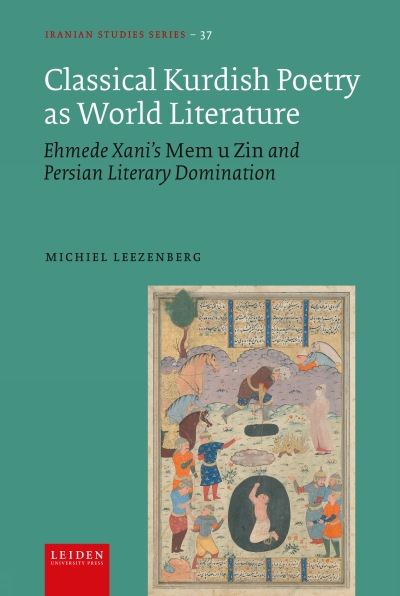
Among Kurdish readers, Ehmedê Xanî’s seventeenth-century romance Mem û Zîn has long been recognized as the national epic, but it has received remarkably little attention among literary scholars. This study provides a detailed analysis of Xanî’s masterpiece, which seeks to break free of the conceptual and normative confines of modern Kurdish nationalism within which it is usually read. It analyses, first, which norms and notions of ethnic, national, gendered and sexual identity may be found in the poem, adding historical depth to discussions about the poem’s nationalist message. Second, it discusses the poem’s background in the classical Persian literary and mystical tradition, and in particular in poets such as Nizami Ganjavi and ‘Abd al-Rahman Jami. Third, it proposes a reading of the poem as ‘world literature,’ surveying its circulation across languages and genres from the early eighteenth century to the present. In this context, it also proposes a critique of what has been called ‘Persianate literary civilisation’ or ‘the Persian cosmopolitan,’ by reanalyzing this cosmopolitan tradition as a premodern form of literary domination, and vernacular poetry as premodern literary resistance. As such, it should be of interest to scholars and students in Kurdish and Persian Studies as well as literary history, comparative literature, and postcolonial and decolonial studies.
Michiel Leezenberg teaches in the departments of Philosophy and Ancient Studies of the University of Amsterdam. Over the years, he has published widely on the history, culture and politics of the Kurds. He has held visiting positions in, among others, the departments of Kurdish and Persian at INALCO/Sorbonne (Paris) and the department of Iranian Studies at the Jagiellonian University (Cracow). Among his publications in book form are Glimpses of Agony: The Kurds as Subaltern Actors in Islamic and Middle Eastern History (SIAS Lectures no. 13, Sophia University, Japan), History and Philosophy of the Humanities: An Introduction (with Gerard de Vries), and an award-winning history of Islamic philosophy (in Dutch).
“Ehmedê Xanî’s Mem û Zîn has long been hailed as the Kurds’ national epic; scholars and nationalists have read the work as an early expression of national sentiment, deploring division and calling for unity. Leezenberg’s study, based on years of careful reading of the entire work, represents a considerable advance on earlier Xanî scholarship. Placing the work in the broader context of Persianate literature and drawing special attention to theme of love and the Sufi symbolism, he brings out many aspects that were hitherto neglected and shows the subtle sophistication and symbolic richness of Xanî’s work.”
Farangis Ghaderi, Director of the Center of Kurdish Studies, University of Exeter,
“A groundbreaking contribution to literary scholarship, this book offers a sharp and original reading of one of the most celebrated Kurdish epics; it moves beyond dominant nationalist interpretations of the epic to reveal its overlooked complex and rich dimensions. In doing so, it not only reshapes our understanding of the epic itself but also highlights its distinctive place within the Persianate and world literary traditions. It also exposes the hierarchies of literary studies, revealing how ‘minoritized’ literatures are excluded—and what those exclusions erase.”
Martin van Bruinessen, University of Utrecht
“Ehmedê Xanî’s Mem û Zîn has long been hailed as the Kurds’ national epic; scholars and nationalists have read the work as an early expression of national sentiment, deploring division and calling for unity. Leezenberg’s study, based on years of careful reading of the entire work, represents a considerable advance on earlier Xanî scholarship. Placing the work in the broader context of Persianate literature and drawing special attention to theme of love and the Sufi symbolism, he brings out many aspects that were hitherto neglected and shows the subtle sophistication and symbolic richness of Xanî’s work.”
Farangis Ghaderi, Director of the Center of Kurdish Studies, University of Exeter,
“A groundbreaking contribution to literary scholarship, this book offers a sharp and original reading of one of the most celebrated Kurdish epics; it moves beyond dominant nationalist interpretations of the epic to reveal its overlooked complex and rich dimensions. In doing so, it not only reshapes our understanding of the epic itself but also highlights its distinctive place within the Persianate and world literary traditions. It also exposes the hierarchies of literary studies, revealing how ‘minoritized’ literatures are excluded—and what those exclusions erase.”