
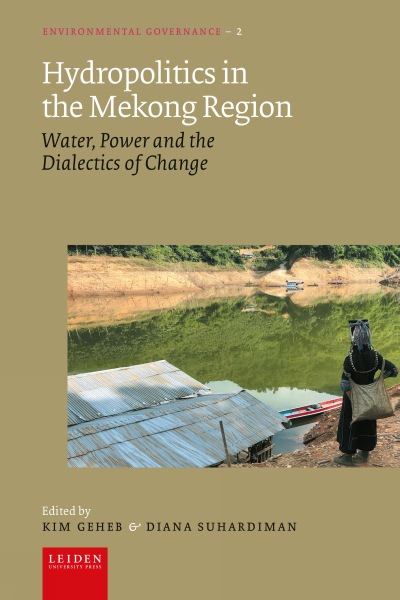









Hydropolitics in the Mekong Region

Water, Power and the Dialectics of Change

Editor: Kim Geheb & Diana Suhardiman

Omslag EG Hydropolitics Mekong Region ΓÇô Geheb HR

About this book

This book is due to be published in September 2026, it is now available on backorder. 

Mainland Southeast Asia’s great river systems sustain the world’s largest inland fishery and provide food security for over 60 million people. Yet these extraordinary systems are being fundamentally transformed by hydropower development, with consequences that will reverberate for generations. Hydropolitics in the Mekong offers a critical analysis of how this transformation is unfolding across the region — not as an unfortunate byproduct of progress, but as the deliberate outcome of power relations operating across multiple scales. Drawing on political ecology, hydrosocial theory, and critical work on development narratives, this volume demonstrates that the rivers of mainland Southeast Asia are being perpetually reconstituted through hydropolitical processes that pattern space, determining what flows and what is blocked, who benefits and who bears costs.

The contributors show how narratives do not merely describe these transformations but constitute the very spaces within which they proceed. Terms like ‘sustainable hydropower,’ ‘win-win cooperation,’ and ‘the Battery of Southeast Asia’ function as nirvana concepts — future-oriented promises that cannot be falsified in the present, directing attention toward luminous horizons while costs accumulate unremarked. Spanning empirical cases from China’s Yunnan Province to Vietnam’s Mekong Delta, from Myanmar’s Salween to Cambodia’s Tonle Sap, the chapters examine how provincial interests complicate narratives of Chinese state hegemony; how ‘hydrocorruption’ drives Lao dam-building regardless of economic rationale; how state capture shapes Tonle Sap fisheries governance; how sediment has only recently entered regional discourse despite its profound ecological significance; and how Karen communities are constructing alternative territories of life through the Salween Peace Park.

Throughout, the volume traces how regional institutions like the Mekong River Commission have been simultaneously conserved and dissolved — maintained in form while emptied of regulatory content. By revealing how hydropolitical assemblages are produced and operate across the region, by attending to whose voices are amplified and whose silenced, Hydropolitics in the Mekong provides essential reading for scholars and practitioners seeking to understand — and challenge — the politics of water in mainland Southeast Asia.

Kim Geheb is a geographer and Senior Researcher at the Center for International Forestry Research-The World Agroforestry Center. His research interests focus on the political ecologies, and the management and governance of natural resources systems. He is based in Nairobi, Kenya.

Diana Suhardiman is a professor of natural resource governance, climate and equity at Leiden University and director at KITLV. Putting power and politics central in the contemporary struggles of natural resource governance, her most recent research looks at grassroots climate governance in Southeast Asia, where she focuses on the politics of knowledge (re)production processes in various socio-ecological systems. Her research looks at various forms of knowledge (re)production processes including through unconventional knowledge systems and other ways of knowing, embedded in lived experience, memories, and the arts.

Available on backorder

Format: Hardback

Pages: 268

Illustrated: Black & White

ISBN Print: 9789087284206

Published: 9 September 2026

Language: English

Related products

X

Be the first to hear about the latest news and publications of LUP.

Skip to content
Leiden University Press logo
Privacy Overview

This website uses cookies so that we can provide you with the best user experience possible. Cookie information is stored in your browser and performs functions such as recognizing you when you return to our website and helping our team to understand which sections of the website you find most interesting and useful. Read our full privacy & cookies statement.