Every October, Maand van de Geschiedenis (Dutch History Month) invites us to look at the past from new perspectives. History is more than a record of events, people, and places: it is also a story of connections, exchanges, and transformations that continue to shape our world today.
For Dutch History Month 2026, Leiden University Press (LUP) highlights four books that offer fresh insights into the past. From the movement of medical knowledge across empires to the environmental consequences of warfare, the reading habits of the eighteenth-century Dutch Republic, and the relationship between the Dutch monarchy and colonialism, these publications demonstrate how historical research can challenge familiar narratives and reveal overlooked stories.
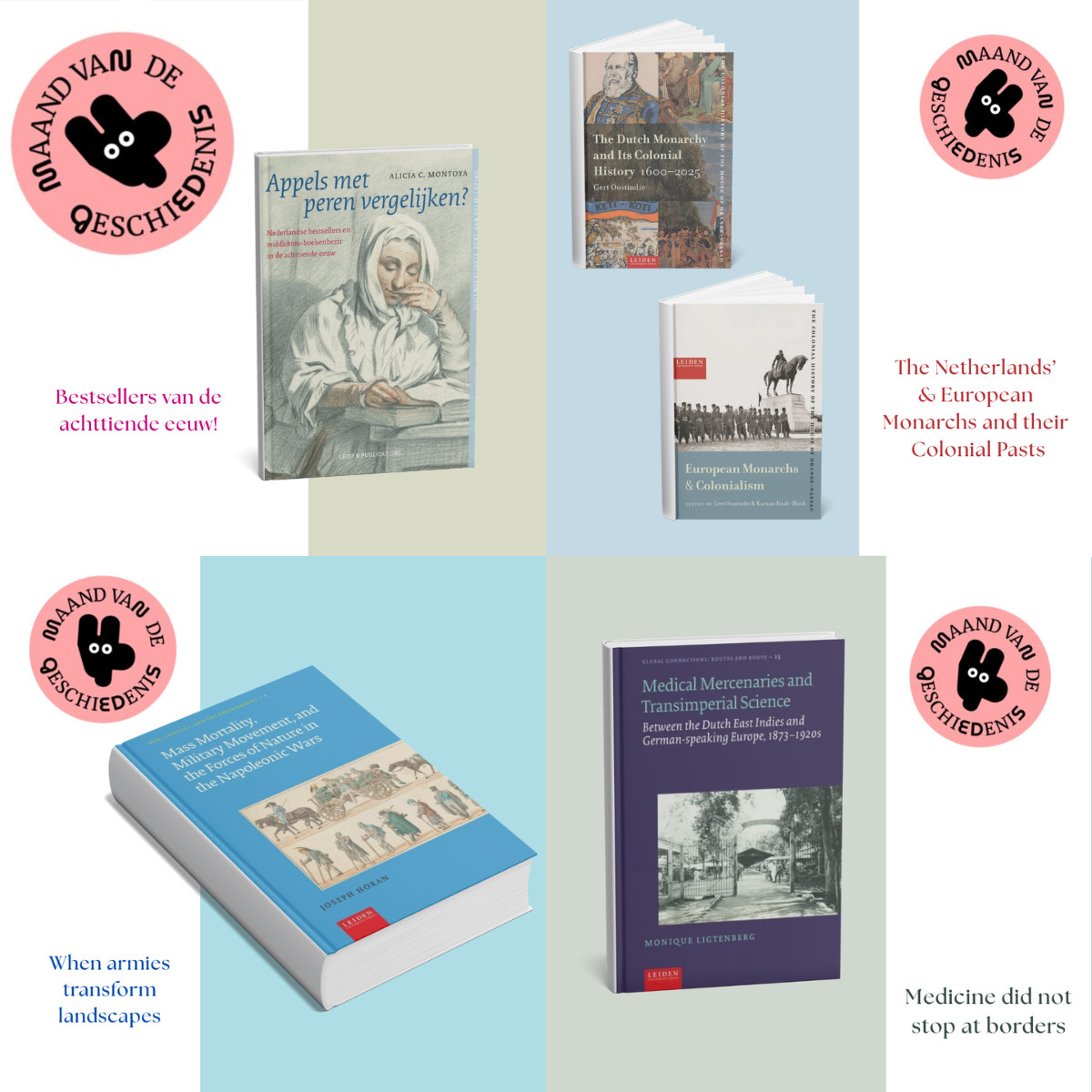
In Medical Mercenaries and Transimperial Science, Monique Ligtenberg follows approximately 300 German-speaking physicians who worked in the Dutch East Indies between the 1870s and the 1920s. Their experiences reveal a complex history of medical exchange that went far beyond the one-way transfer of European knowledge to the tropics. Discover the book: https://lup.nl/publications/history/dutch-history/medical-mercenaries-and-transimperial-science/
Wars are often remembered through battles, military leaders, and shifting borders. Yet the history of warfare also unfolds through landscapes, ecosystems, and the everyday experiences of soldiers and civilians.
Mass Mortality, Military Movement, and the Forces of Nature in the Napoleonic Wars examines how military campaigns transformed the environments through which armies moved. Hunger, exposure, and epidemic disease shaped the experiences of people caught up in the wars, while soldiers, animals, plants, and microbes travelled alongside military forces — sometimes spreading far beyond the battlefield. Discover the book: https://lup.nl/publications/uncategorized/mass-mortality-military-movement-and-the-forces-of-nature-in-the-napoleonic-wars/
In Appels met peren vergelijken? Nederlandse bestsellers en middlebrow-boekenbezit in de achttiende eeuw, Alicia C. Montoya investigates how we can reconstruct the popularity of books and authors from the past. Drawing on historical auction catalogues of private libraries, she maps book ownership and reading culture in the eighteenth-century Dutch Republic. Discover the book: https://lup.nl/publications/history/book-history/appels-met-peren-vergelijken/
In The Dutch Monarchy and Its Colonial History, 1600–2025, edited by historian Gert Oostindie, scholars examine the relationship between the House of Orange-Nassau and the Dutch colonial empire over four centuries. The book asks important questions about the royal family’s role in colonial expansion, slavery, economic exploitation, and colonial warfare. Discover the book: https://lup.nl/publications/history/dutch-history/the-dutch-monarchy-and-its-colonial-history-1600-2025/
Together, these four publications illustrate the breadth of historical research at Leiden University Press. They remind us that the past rarely fits into a single narrative. By investigating overlooked experiences, tracing connections across borders, and questioning established interpretations, historians help us better understand how our world came to be — and why these histories continue to matter.
This Dutch History Month, we invite you to explore these books and discover new perspectives on the histories that connect us.
Explore the publications of Leiden University Press: https://lup.nl/